Search This Blog

Friday, July 19, 2013

Visit to Michigan Organic Hops

Today, I had the great opportunity to visit Lyle at his hopyard and farm (Lyle Schmidt Farms, LLC) in Mendon, MI. "Certified" Organic since 2006, the farm sits in the heart of the rolling hills, forests, and lakes of southwest Michigan, a short drive to the St. Joseph river. Lyle grew up on the farm, and typically works there 5 days per week, but technically lives in Cincinnati, OH. In addition to several varieties of hops, Lyle grows organic fruits and vegetables, barley, oats, rye, and also an heirloom variety of free pollinating corn he intends to sell to a distillery near Lansing. The majority of the hops are sold to local craft breweries.


The hopyard consists of a 1.25 acre plot on a south facing hill above a vineyard. Hops grow vertically up coir lines on a 21' trellis supported by black locust poles (tree trunks, essentially) buried 3' in the ground. There is a pole every 53' and rows are 480' long. Being such a "small" hopyard, large motorized equipment is not cost-effective, but he does use an 18' tall siege machine-looking cart structure built on a trailer (sorry, I did not take a picture of it) where workers ride and spray the bines and other maintenance. At harvest time, the lines are cut at the top and bottom, loaded on a trailer, and transported up to the Michigan Hop Alliance in the Traverse City, MI area where they are stripped and the cones are pelletized and packed in nitrogen.

After showing me the hopyard, Lyle had a few minutes to share some of the homebrew I brought. We tried my Sour Pumpkin beer, and I also gave him a couple of saisons to try before I left (I thought a "farmhouse" ale would be appropriate). I really appreciated Lyle's hospitality and willingness to set aside some time from his busy day to show me around and chat for awhile. It was very interesting to get the perspective of a larger hop-growing operation than I am used to (although his is still rather small in comparison to other farms). I encourage anyone interested to seek out Lyle and his products, as well as the rest of what southwest Michigan has to offer. If I am able, I may go out again at harvest time to hand-pick some fresh hops. Even if you are not able to come to Michigan, I encourage you to explore your surroundings and discover the products available to you locally. These activities may not involve fermented foods or beverages, but they certainly require an adventurous and creative spirit. Be Fermentive!

Wednesday, July 10, 2013

DMS Surprise: Follow-up

You may recall a recent post entitled "DMS Suprise?" This post talked about my experience of DMS (a creamed-corn flavor/aroma) in an English Mild brewed in May '13. Unfortunately, said DMS has not "aged out" over time. However, I am happy to report that in one version of this beer--brewed with 0.5 oz. culinary lavender in the boil and 1.0 oz. in secondary--the DMS is much less prominent. At this point, my thought is that in the offending beer, the naturally occurring DMS came through due to the weak malt backbone (only 3.1% ABV). In the lavender mild (which is quite nice and refreshing, if a bit "soapy," and "grandma-y"), this off-flavor/aroma is being over-powered by the lavender. I'll have to keep this in mind when brewing future low-gravity beers. Cheers! Be Fermentive!

Batch No. 40!

The following recipe is for kind of a special beer, considering it's my 40th batch and my 1st post-move brew. This past spring, I filled a gallon ziplock bag of spruce tips from the tree in my neighbor's front yard (in my defense, it straddles the property line) to be used in a future beer. Last year, I brewed Gordon Strong's Colonial Stock ale with molasses and spruce tips and really enjoyed it. As Spring has passed and Summer is quickly passing, I have been craving hoppy beers. Before the move, the last hoppy beer I brewed was a Mosaic SMaSH beer back in January and everytime I have one I say to myself, "I really need to brew some IPAs." I've had a pound each of Simcoe and Citra just waiting for me in the freezer, and I finally cracked them open yesterday. I'm calling this an imperial dark American ale with spruce tips: "All Spruced Up: American Dark IPA."

OG: 1.077
IBUs: 81.5

Fermentables:
12# US 2-Row 76.2%
1# Crystal 80 6.3%
0.50# Acidulated Malt 3.2%
0.25# Cara-pils 1.6%
0.25# Special B (SRM 180) 1.6%
0.25# Carafa III (SRM 525) 1.6%
1.5# Table Sugar 9.5%

Hops:
0.50 oz. Simcoe (90 min. first wort hop) 21.4 IBU
1.0 oz. Mt. Rainer (90 min. first wort hop) 19.5 IBU
1.0 oz. Citra (15 min.) 19.3 IBU
1.0 oz. Simcoe (15 min.) 18.1 IBU
1.0 oz. Citra (hop stand 30 min.)
1.0 oz. Simcoe (hop stand 30 min.)
0.5 oz. Citra (Dry-hop at least 7 days)
0.5 oz. Simcoe (Dry-hop at least 7 days)

Procedures:
90 minute boil. Add approx. 1 gallon ziplock back spruce tips at 60 minutes. Boil 60 minutes. For hop stand: after flame-out, wait until wort is barely steaming; add hop stand hops; steep, covered. Add boiled, cooled sugar to primary after majority of fermentation is complete. This dries out the beer, but encourages yeast to metabolize more complex sugars first.

I'll be doing a series of hoppy beers for the remainder of the summer, including a fresh, homegrown hop harvest ale. Enjoy! Be Fermentive!

Moving Day

Disclaimer:  This post is not entirely beer related.

If beer and homebrewing is one of my strengths/interests, moving is it's complete antithesis. I hate anything to do with packing or moving and have absolutely zero aptitude for these activities. It is a mild exaggeration, but I've been known to say that I would rather experience a death in my family than to move. Needless to say, my family recently moved from Illinois to Michigan (the site of the National Homebrewer's Conference in June 2014; Be There!). This meant selling nearly an entire garage full of stuff in a yard sale, and still having enough stuff to completely fill a 26' moving truck (notice the 14 cases of homebrew; bottom left) and two vehicles. Though I find this capitalistic glut embarrassing at an existential level of Carlinian proportions, I had to move it or suffer the consequences. But I digress.

This post is mainly to give a shout out to my friends and family members without whose help this move would simply not have happened. I won't mention their names, but you know who you are. This shout out includes both those who shed sweat and blood, but also those who housed me later in the week when I picked up my kids from their grandparents' house. A sincere THANK YOU to all!

Friday, June 28, 2013

Beer Books I've Enjoyed

Here are some of my favorite books about beer, brewing, etc.

Charlie Bamforth:

"Beer is Proof that God Loves Us: Reaching for the Soul of Beer and Brewing"
   -A great look at beer and brewing from a titan in the brewing sciences community. A spiritual perspective on beer (in a good way). One of the best personal narratives on beer that I've read. Very enjoyable read.

"Beer:  Tap Into the Art and Science of Brewing"
   -An extremely informative and entertaining writer, Charlie Bamforth expounds upon his great wealth of brewing science. This book contains much of the same information as his other books, but is worthwhile in its own right if you've read other Charlie Bamforth works.

Charlie Papazian:

"The Complete Joy of Homebrewing, 3rd edition"
   -The first major publication from the Godfather of homebrewing, Charlie Papazian. A nuclear engineer turned homebrewing and craft beer evangelist, Mr. Papazian has introduced millions to the joy of homebrewing. Although there may be better primers available, The Complete Joy is arguably one of the most iconic. It has some excellent stories and black & white photos.

"Microbrewed Adventures: A Lupulin Filled Journey to the Heart and Flavor of the World's Great Craft Beers"

   -Microbrewed Adventures is not a How-to book, but more of a travel journal of Charlie Papazian's experiences traveling the world in search of what the world has to offer beer drinkers. It contains great stories about beer, travel, as well as recipes not found in other of Papazian's works. Pick this one up to gain insight into the heart and soul of The Godfather of homebrewing.

Dennis Fisher & Joe Fisher:

"The Homebrewer's Garden: How to Easily Grow, Prepare, and Use Your Own Hops, Malts, and Brewing Herbs"
   -The Homebrewer's Garden does just what the title implies: provides information on how to grow and use hops, cereal grains, and other plants for use in homebrewing. It contains useful diagrams of hop trellises, malting equipment you can easily build, and descriptive lists of little known brewing herbs. It also contains valuable gardening information regarding soil composition and how to make the most of your homebrewing garden.

Gordon Strong:

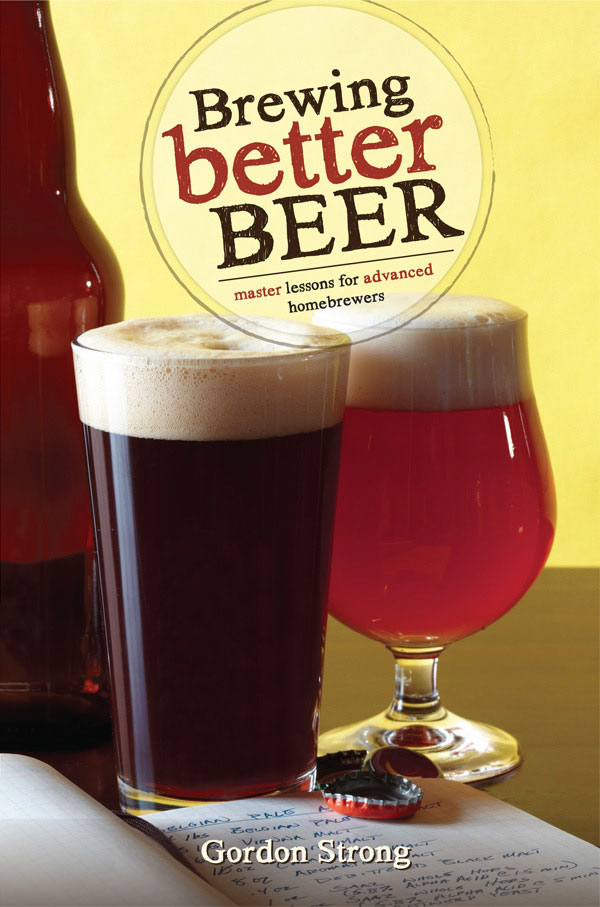
"Brewing Better Beer"
   -This book, written by 3-time Ninkasi Award winner, Gordon Strong, is not (necessarily) for the novice homebrewer. Lacking an introduction to homebrewing (widely available in other books in this list), Strong assumes that his audience already knows how to brew beer. His goal is to help them brew "better" beer. He approaches his topic from a philosophical perspective, and includes an introductory chapter that outlines his philosophy of Zen and the art of brewing. Including some very interesting stories, Strong schools the reader in all things "better," with an emphasis on Brewing for Competition. As the highest ranking judge and primary writer of the Beer Judging Certification Program (BJCP) style guidelines, he knows a think or two about competitions (if you're into that sort of thing). There's some genuinely good brewing advice, too.

John Palmer:

"How To Brew"
   -Although I don't own a copy of this book, I have read a lot of it. Much of it is available online. It is arguably within the top 2, if not THE foremost homebrewing how-to book available on the market today. In it, John Palmer guides the homebrewer through novice, intermediate, and advanced brewing techniques. He makes complex procedures and concepts accessible without dumbing them down. There are also unique sets of information not found in other homebrewing primers, including the metallurgy of brewing and black and white photos of a younger, thinner John Palmer among others (John Palmer was trained as a metallurgical engineer and, oddly enough, hails from Midland, Michigan). He also co-wrote Brewing Classic Styles with Jamil Zainasheff, and will soon be releasing a book on water chemistry with Colin Kaminski. 

Randy Mosher:

"Tasting Beer: An Insider's Guide to the World's Greatest Drink"
   -Also author of Radical Brewing, Randy Mosher is a graphic designer (clearly evident in this book) and beer evangelist, who also teaches courses at Chicago, Illinois' famed Siebel Institute. Tasting Beer shares stories and extensive knowledge on beer, beer tasting, and pairing beer with food. It does not provide detailed instruction on brewing, and does not purport to do so. Aside from Garrett Oliver's book (which, in fairness, I have not read), Mosher provides one of the most impassioned and accessible books on pairing beer with food, etc. Pick it up. You won't be disappointed.

Stan Hieronymus:

"For the Love of Hops:  The Practical Guide to Aroma, Bitterness, and the Culture of Hops"
   -This book is part of a series of books by Brewers Publications which presents a compendium on each of the four main ingredients in beer:  water, yeast, malt, and hops. I had intended to finish reading the book before publishing this post, but alas I have not. All I can say is that, so far, the book is well-written, detailed, and very interesting. It's intended audience is professional brewers and homebrewers alike. It includes such topics as hop breeding, cultivation, in addition to aroma, bitterness, etc. I may provide a more detailed review in the future, but that will have to wait for now. Nevertheless, pick it up. Some of you may reading it while sitting on the toilet as I write this post. Stan Hieronymus has written a number of other gems worth a look.

Michael Jackson:

The British beer writer/journalist, not the pederast. Michael Jackson (now deceased), was the authority on beer writing long before the advent of the American craft beer revolution. He has written a large bibliography of works on beer, scotch, and whiskey. He, along with a few others, helped to bring light to beer culture around the world. A force to be reckoned with in the pantheon of beer notables, any of his works will prove to be joyfully written, encyclopedic, beautifully illustrated, and artfully photographed. 

As you continue your quest of great beer, whether that be homebrew or other great beers, bring along a little light (or heavy) reading. Above all, be fermentive.

Sunday, June 9, 2013

DMS Surprise?

Aside from my 17.5% ABV barleywine (which tastes awesome), I have been brewing several session beers this Winter/Spring. Some of the most easily recognized session beers in the world are the British milds and bitters. In a previous post, I outlined the recipe for a Cain's Finest Bitter clone. The yeast for this brew was kind of special. It was Wyeast 1469 West Yorkshire yeast. If you ever brew with this yeast, you may want to decide if its description compares with your experience of its ester profile. The reason I say this is because I had a rather disconcerting experience with this yeast. Although the fermentation progressed as per usual on all three beers it fermented, even a few weeks after bottling the beer produced a rather strong creamed corn aroma and flavor.

"DMS! Oh, no!" I thought. This was a very troubling thought because I consider myself a pretty good brewer and have never had a problem with DMS (Dimethyl Sulfide). DMS is a natural component in beer, especially light colored lagers, but it should not have been a problem in these particular beers because of their dark color and because of my procedures. But the corn was unmistakable, nevertheless. What to do? After sharing and discussing with my brother-in-law without coming to any conclusions, I decided to go out on a limb and send Jamil Zainasheff an email. Here is the contents of my email and his response:

Hi Jamil,

This is Travis from Illinois. I've been brewing all-grain for around 30+ batches now, and this is the first time I've ever had any issues with DMS. I recently brewed a series of session beers (milds and bitters below 4%) pitched on a Wyeast West Yorkshire yeast cake. I did not change any of my procedures for these beers. My rolling boil was uncovered, and wort was cooled from boiling to below 70F in approx. 10 min. Fermentation began after minimal lag time and krauzen appeared normal. The beers were bottled per normal procedures (which have never yielded DMS in the past). Upon pouring, the beers have quite a strong "creamed corn" aroma and flavor. Although I wondered about infection, it seems unlikely as the smell is not of rancid or cabbage (Palmer, J.; How to Brew). I suppose it is possible that I simply did not boil vigorously or long enough, but this would surprise me as I said because my procedures were not altered. In addition, each of these (5.5 gallon) batches contained Special Roast and black malt, which I would think would go a long way to cover up any naturally occurring DMS (the base malts were pale and/or mild malts). I wonder, however, if my grain bill was not substantial enough (flavor-wise) to cover up the DMS. I know it's difficult to diagnose problems based on the information in an email, but I'm curious about your thoughts. Thanks.

Much respect and admiration,

Travis
-------------------------------------------------------------------------------------------------------------------------------------------------------------------

Travis,
I would suspect maybe the base malt? Is this a new malt you haven't used before? Other possible thoughts are it isn't DMS but something else? Is this the first time you've used the West Yorkshire? Sometimes people are thrown by the extensive ester profile of the WY yeast. Nothing else comes to mind, but like you say, it is hard to say without tasting.

JZ
-------------------------------------------------------------------------------------------------------------------------------------------------------------------

So, at that point, I was still somewhat baffled. It was also a good feeling to know that the only thing separating me from homebrewing legend and (now) professional brewer, Jamil Zainasheff, is experience. I wasn't ready to throw out three batches of homebrew, so I decided to wait. I just opened some of these last night (about 1 month after bottling), and the offending aroma and flavor had greatly diminished. Maybe it was the yeast just taking its time to drop out. I'm quite happy with the results (compared to my previous impressions) and will continue to experiment with session beers fermented by this yeast. There is a link above for the Cain's Best Bitter clone. Here is my (still developing) mild recipe:

(Not Quite) Pale Mild

5-gallon batch
OG: 1.032
ABV:  ~3.0%
Color:  14.1 SRM
18.8 IBUs

Grist:

4.75# Mild Malt (4 SRM) 86.4%
0.25# Chocolate Malt (450 SRM) 4.5%
0.50# Table Sugar 9.1% @ 15 min.

Hops:

0.25 oz. East Kent Goldings (7.2 IBU) @ 45 min.
0.75 oz. Eask Kent Goldings (11.7 IBU) @ 15 min.

Yeast:

Wyeast 1469 West Yorkshire strain

Procedures:

Mash @ 155 for 50 min.
Mash out @ 168 for 10 min.
Boil, chill, aerate, pitch yeast, ferment @ mid 60s.

As mentioned, you may want to wait several weeks to drink after bottling, or suspend judgment on their flavor and aroma if sampling early. Enjoy, and be fermentive!

das Geständnis Bavarian Wheat (google it)

I have a confession to make, thus the name of this Bavarian Wheat beer. You may recall in my last post that I was trying to think of what to brew next. I made much ado about simplicity and zen and philosophy, etc. I evangelized on slimming down the 7+ malt/hop recipes of the novice homebrewer (recommendations I still believe in). However, I confess that after making a big stink about recipe formulation, I never even brewed that recipe. In fact, I brewed something completely different albeit (in my defense) simple:  a Bavarian wheat beer. I still plan to brew the Rye Pale Ale (I really enjoy rye), but I had some yeast I needed to use and some left over grain in the right amounts. So, I threw caution to the wind and went for it. Here's the recipe.

5-gallon batch
Est. OG:  1.044
3.8 SRM
11.4 IBUs
YMMV

Grist:

White Wheat Malt - 67.2%
Pale Malt (Ger.) - 32.8%

Hops:

0.50 oz. Mt. Rainer hops @ 60 min. (11.4 IBU)

Yeast:

slurry from 1/2 gallon starter of Wyeast 3638 Bavarian Wheat

Procedures:

Dough-in @ 107F with 16 qts. water for 20 min.
Protein rest:  Heat to 122F, hold for 10 min.
Heat to 148F, hold for 30 min.
Heat to 158F, hold for 20 min.
Mashout:  Heat to 168F, hold for 10 min.
Sparge, boil, chill, aerate, pitch, ferment at approx. 64F (upper 60s for more banana/less clove, lower 60s for more clove/less banana).

I've since bottled and tasted this lovely, if slightly weak, Hefeweizen. It's quite nice. Very sessionable, with pleasant clove-y tartness. Enjoy, and be fermentive!